
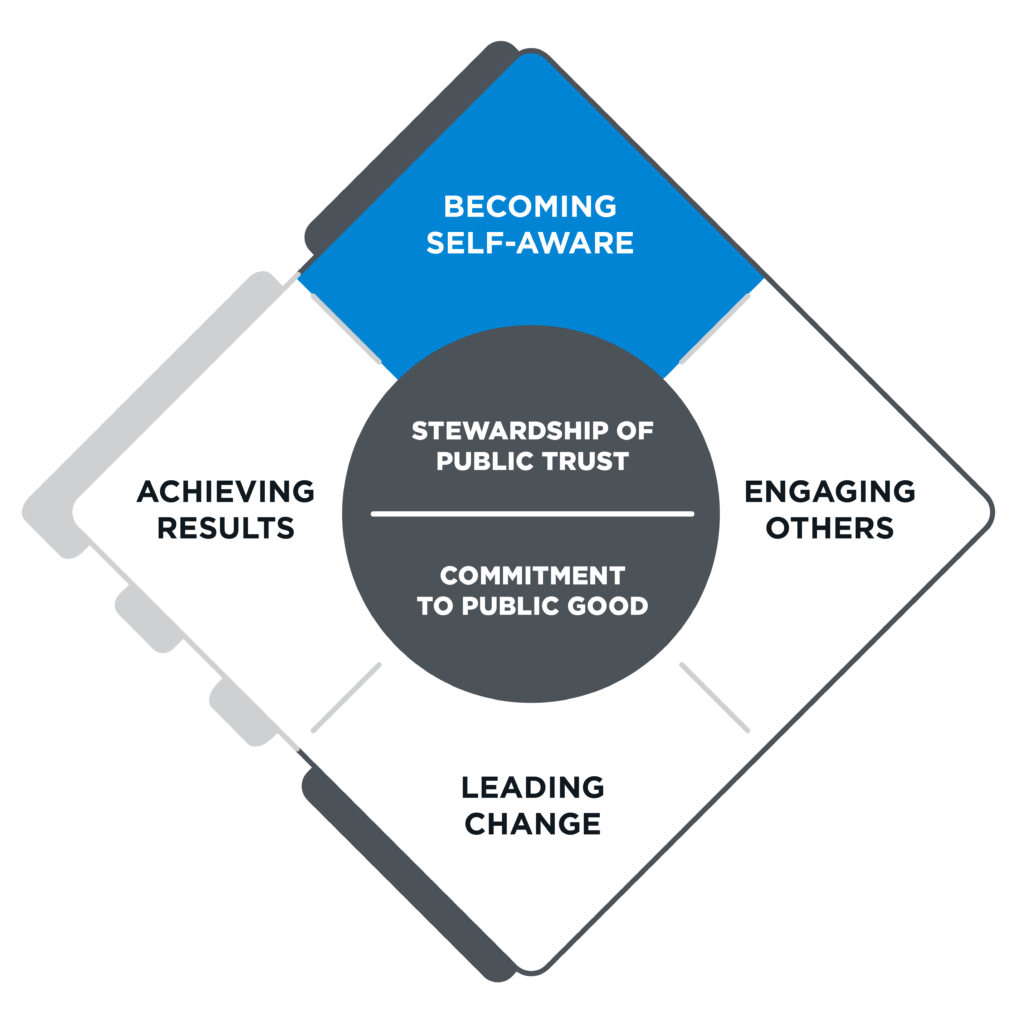
 Becoming self-aware is about knowing how your values and motivations drive your behavior. It is essential to personal development and the ability to interact productively with others. In a complex environment, self-awareness is an anchor, enabling you to stay true to yourself and perform at your highest levels. The five subcompetencies to becoming self-aware include:
Self-Reflection
Regularly reflect, test assumptions and seek feedback.
“Without reflection, we go blindly on our way, creating more unintended consequences, and failing to achieve anything useful.”
– Margaret J. Wheatley, Writer and organizational behavior consultant
PUBLIC SERVICE LEADERSHIP IN ACTION
Four tips to help you complete a self-assessment
Whether you are a leader, or aspiring to be one, ensure you are doing the best work for your team by taking the time to…
Les Lyles’ Leadership Journey
General Les Lyles shares the story of his leadership journey in service to the country, including notable points of self-reflection on values and contribution.
Clarity in the Future Through Self-Reflection
Ms. Vicky Herrera speaks about the importance of self-reflection and how it allows people to gain clarity for the future. She emphasizes on the approach of looking within oneself to know how to ask the right questions and to know how to answer them.
Reflective Questions
- What strengths do I bring to my work?
- In what areas do I feel unsteady and want to improve?
- How will I seek continuous feedback about my performance? Who are my trusted sources for feedback?
Additional Resources
READ: How A Daily Self-Reflection Practice Improves Leadership Performance – Naz Beheshti, Contributing writer and consultant, Forbes
READ: A Time for Reflection: Understanding Yourself in Times of Change – Stacie M. Rivera, Public Affairs Specialist at Veterans Affairs, GovLoop
WATCH: The Science of Character – Tiffany Shlain, filmmaker, author, public speaker
Authenticity
Align your actions with your values.
“Authentic Leaders are not afraid to show emotion and vulnerability as they share in the challenges with their team. Developing a solid foundation of trust with open and honest communication is critical to authentic leadership.”
– Farshad Asl, The “No Excuses” Mindset: A Life of Purpose, Passion, and Clarity
PUBLIC SERVICE LEADERSHIP IN ACTION
Authentic leadership: Why showing up as yourself matters
Understand what authentic leadership is, why it’s important it’s an important trait in today’s workforce, and how to better demonstrate it to your colleagues.
Doug Conant on Being Self-Aware
Doug Conant reflects on his career as former CEO and president of Campbell Soup Company pinpointing a vital element for a successful leader – self-awareness.
Improve Leadership Presence
Muriel Maignan Wilkins, co-author of Own the Room, talks through the three essential elements of having a positive presence – assumptions, communication strategy, and your energy.
REFLECTIVE QUESTIONS
- How do I want to be known to others? What qualities of myself are most important to demonstrate?
- In what situations or with what people do I tend to:
- Hide or downplay myself or my strengths, or
- Fear admitting my flaws, or
- Forget my personal boundaries, or
- Feel as if I’m not good enough, or
- Create pressure to “fit in”
- Examining the above situations or people, what might be contributing to this tendency to shy away from authenticity?
Additional Resources
READ: Seeking Authentic Leadership? – Ruth McGowan, Research Scientist and consultant
WATCH: Authentic Leadership – Dana Born, retired brigadier general in the United States Air Force
WATCH: The Authenticity Paradox – Herminia Ibarra, Author and Professor of Organizational Behavior at London Business School
Emotional Intelligence
Recognize your emotions and those of others; use this information to manage behavior.
“I’ve learned that people will forget what you said, people will forget what you did, but people will never forget how they made you feel.”
– Maya Angelou, Civil rights activist, poet, author
PUBLIC SERVICE LEADERSHIP IN ACTION
Managing the Ebola Crisis
Read about Mia Beers’ success in helping manage the ebola crisis in West Africa while also considering the emotions and customs of both the affected communities and her USAID team.
Empathy is the most important leadership skill
A new research study from Catalyst shows how leaders that demonstrate empathy towards their colleagues yield positive impacts on engagement, productivity, and stress.
How Kindness Contributes to Leadership
Listen to General Les Lyles talk about how kindness contributes to leadership effectiveness.
REFLECTIVE QUESTIONS
- How might I practice paying attention to my experience and being present?
- When I’m feeling stressed, what techniques do I use to cope?
- What is my level of awareness about how emotions play into my work? The work of others?
Additional Resources
READ: 5 Skills to Help You Develop Emotional Intelligence – Mark Manson, Author and personal development consultant
WATCH: Empathy vs. Sympathy – Brené Brown, Research Professor and author
WATCH: Strategies to Become More Emotionally Intelligent – Daniel Goleman, Author and behavioral scientist
Integrity
Follow moral and ethical principles.
“In looking for people to hire, look for three qualities: integrity, intelligence and energy. And if they don’t have the first, the other two will kill you.”
– Warren Buffett, CEO of Berkshire Hathaway and philanthropist
PUBLIC SERVICE LEADERSHIP IN ACTION
Shaping the Government’s Legal Position
Learn about Edwin Kneedler’s unwavering integrity and candor as he has worked to tell his clients’ stories fairly and uphold the U.S. Constitution throughout his career at the Department of Justice.
Charlie Bolden on Leading in Government
In this interview, former NASA Administrator Charlie Bolden talks about the unique nature of leading in government and keeping the public good as the focus.
Success Will Come and Go, But Integrity is Forever
Learn how building trust on an individual level, will produce major payoffs in the future.
REFLECTIVE QUESTIONS
- What moral principles tend to guide my work?
- Think back to a time when faced with an ethical dilemma. How did I handle it? What did I learn from it?
- Am I inclined to “do the right thing, even when no one is looking?” What helps or hinders me in practicing integrity?
Additional Resources
READ: Leading with Character: Integrity – Michael Lee Stallard, author of Connection Culture: The Competitive Advantage of Shared Identity, Empathy and Understanding at Work
READ: Why Integrity Remains One of the Top Leadership Attributes – Terri Williams, Economist contributing author and journalist
WATCH: Simplifying Humility and Integrity – Joe Sibini, Ted Talk speaker
Continuous Learning
Constantly seek to grow and learn.
“Leadership and learning are indispensable to each other.”
– John F. Kennedy, President of the United States
PUBLIC SERVICE LEADERSHIP IN ACTION
How to Foster a Culture of Continuous Learning
Ashu Goel, CEO of WinWire Technologies, discusses his insights on continuous learning as an individual leader, and how best to ignite a culture of learning on your team.
Why a Service to America Medals winner decided to participate in the Excellence in Government Fellows Program
Omar Perez Aybar won a Service to America Medals award in 2014 for his work investigating Medicare fraud in South Florida.
Advancing Medical Science
Discover the genius of Ann Mckee, who has spent her career advancing medical science in the field of head trauma through extensive research and study of environmental impacts on the brain.
REFLECTIVE QUESTIONS
- How often am I taking time for formal learning? Informal or on-the-job learning?
- What sources of feedback do I have on my performance and my professionalism?
- How will I capture or codify what I’m learning?
Additional Resources
READ: Future of Work Requires Leaders Who Value Learning in the Flow of Life – Amy A. Titus, Managing Director in Human Capital at Deloitte Consulting and ATD contributor
READ: Why Continuous Learning is a Sign of Great Leadership – Sean Jacobson, HR Business Consultant and contributor to Leader2Leader
WATCH: The Backwards Brain Bicycle – Smarter Every Day